

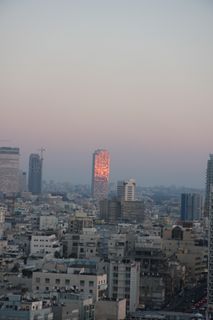
When I told my father that my husband and I were thinking of traveling to Israel he said, “Yetz ist det zeit.” This is Yiddish for “now is the time.” Or, as I thought, now is as good a time as ever. It had been over 25 years since my last visit, and my husband had never been. Quite spontaneously we booked round trip via El Al for a two week, full-on immersion of Israel. We braced for a glimpse into a life that is as much intellectually engaging as it is surprising, lively and intense.
I am sure that the deterrent that kept us from visiting Israel before now was the issue of safety. But let me be clear: I felt safer in Israel than I do driving on the freeway in Los Angeles alone at night. Whether there or here (for I write this now on home turf), it is surreal to think that this small, but not quaint, country (230 square km) can coexist wedged as it is between Jordan, Egypt, Lebanon, Syria, and of course, no-man’s land, the West Bank and the Gaza strip. Perhaps because of this awkward geo-political placement and ancient confluence of conflict the Israeli people thrive on a voracious appetite for life, and an intensity that justifies their commanding presence. Oh yes, Israel has an edginess to it, with its scrutinizing check points, presence of military youth bearing arms at tourist venues, and ALWAYS security guards checking you out as you pass thru whatever portals. Such is the look and smell of safety, and a reassuring one at that.
But I promised early on in this blog not to hit my dear readers with heavy matter, and I certainly will not alight on political topics for the simple fact that I am not a Middle East expert. (Thankfully.)What I will confirm as I launch into my brief travel log, is that Israel CAN BE a socio-political-historical-cultural gift that keeps on giving for any secular tourist who has stamina to investigate this treasure chest of topics and activities. In other words: DUH! You don’t have to be Jewish to get into it! In fact you are ahead of the game if you have even just a little understanding of the three monotheistic religions born in this backyard. Go ahead: dial Judaism, Christianity and Islam for a good time. On with the travels and follow along with the picture book.
IN THE BEGINNING:
THE WILDERNESS AND THE FIND AT QUMRAN
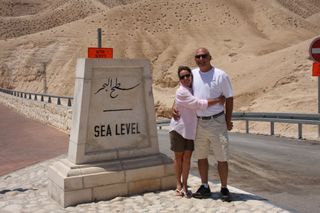
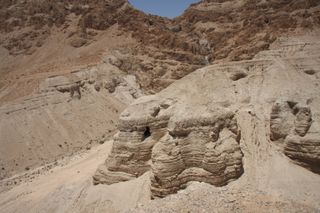
Almost as good as the Old Testament itself (which for me is like the Great Ancient Novel) is the true story of the relatively recent discovery of the Dead Sea Scrolls found in Qumran, an area some 20 miles southeast of Jerusalem. These original handwritten Aramaic, Greek and Hebraic texts predate the Bible, and the debate around their existence is fascinating.
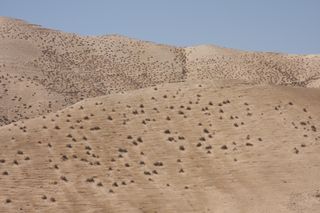
Imagine: a lot of desert, a flock of sheep and very little vegetation. A Bedouin shepherd boy throws a stone into a cave in an attempt to find a lost lamb. Upon hearing clattering from the depths of the cavern he fetches his family. Upon investigation the family realizes the shattering sound is the breaking of an ancient earthenware jar with mostly preserved papyrus scrolls.
Since there were no “comps” of found scrolls for the Bedouin family to price their rare find, they solicited advice from an antiques dealer in the nearby town of Jericho, (still Palestinian territory today). While not fully understanding the significance of the scroll’s content, the dealer recognized this was a unique item and paid the shepherds for their find. A few years later Israeli archaeologist Yigael Yadin saw this mysterious artifact for sale in the Wall Street Journal ad and purchased it from a Syrian source. Yadin then donated the scroll to the state of Israel. By 1956 over 800 scrolls were discovered amongst 11 caves! Today many of the scrolls can be seen at the Shrine of the Book, at the Israel Museum in Jerusalem. Today, the scrolls are considered “the greatest discovery of the Jewish people” for therein describes Jewish political and religious life of the Jews from approximately BC 200 to AD 70. But who was responsible for their existence?
This teeny bit of history that surrounds the discovery of the scrolls is just to wet our whistle. You can read volumes on this and pursue a PHD in it, if you like. You can also google it, or better yet, go to the Shrine of the Book in Jerusalem at the Museum of Israel and see this beautiful domed museum that houses some of the scrolls.
Or just consider as I have, how fortuitous that a shepherd threw a rock into a cave only to find old paper in a broken jar kept dry and crisp thanks to consistent climate control resulting from lack of humidity at a low elevation!
In the end the Bedouin family benefits, Jewish and Christian history is illuminated, and culture crackheads and antiquities brokers have come out ahead from the discovery at the caves above Qumran. (To name a few). It pays to have a wandering sheep!
Next installments:
Masada and the Dead Sea
Elat and Petra, Jordan
The North
Amman, Jordan
Jerusalem, at last!
 MY MUSE
Leave a comment