

We like the idea of a muse as someone who lights a spark and gets you moving. (July 2011 Vanity Fair)
I like the idea of getting my muse to spark a light and get me moving. This time it was reading someone else’s interpretation of a muse that ignited my pilot. Hence I got a treadmill; I’m doing hot yoga ( Bikram) at least once a week for physical and spiritual equanimity (and kick ass); cleaning the art studio, preping a canvas, and just moving on. Moving means making incremental change to effect a bigger change—in me! Good change in me happens when I am committed to my creative instinct as it gives me personal joy. As Eckhart Tolle, one of the great contemporary thinkers of our times reiterates over and over, “follow your joy”. That means to write as well!
Real writers seem to write regardless of life’s ups and downs. OH I GET IT! Life’s ups and downs feed the muse and fuel the flames…ignites the spark. However purging, personal or pretentious the content of this blog may be, I have to go with it—as the muse pushes me to try.
LOOKING BACK
One year ago, July 2010, I wrote about the Neptune Society and it’s unusual underwater burial park in Florida, a subject matter prompting my interest when my mother inquired as to whether a burial at sea was something she needed to enlist. That idea and conversation were abandoned when we had to cope with more tangible issues like her cancer. For, as if the discussion were a curse, my mother was shortly thereafter diagnosed with tongue cancer. (BTW: As in a Grimm fairy tale I briefly imagined that mother was “cursed to” the cancer for some of the more “bitter things” she had uttered over the years.) As these things go the surgery and post surgery was pretty gruesome. I did think Betty might be going the way of the Neptune Society as she lay in the hospital for 3 weeks at 85 years of age, combating multiple infections as one begat another. I would have been in denial to think otherwise.
No matter how you sliced it, (sick pun) I was convinced if oropharyngeal cancer didn’t kill her, the surgery would. But her little body sustained the onslaught. She is now in full remission and the actress who once had perfect “how now brown cow” elocution speaks with a lisp. Stho whath? She can talk! As long as she doesn’t dress like Elmer Fudd! She can’t eat almost everything but she’s very much alive! She even practices Zumba dancing at home with her housekeeper. Her advanced glaucoma prevents her from driving and thankfully her eye doctor insists she stop. As with anyone advancing in life Betty is a bit forgetful and impatient, and so my siblings and I spend more time monitoring her support system, meals, appointments and donations to the American Vet Association which by the looks of the multiple calendars they send her benefits from her generosity. In all fairness we are grateful for her strong will, strong heart and physical aptitude. Her stubborn attitude doesn’t hurt though quite vexing at times.
My father on the other hand didn’t make it. I know many of you dear readers knew Lester, whose life had been blessed with charisma, great health, prosperity, a loving family and a lot of forgiveness. Looking back at the last year I realized the summer of ‘10 was uber (ya think?) stressful, not just because of my mother’s bleak health outlook, but because I knew I was losing Dad. As I said at his memorial service which took place in May, he was my best friend and we spoke almost daily. But as of last summer our “check ins” became fewer and more vague. He didn’t know where I lived or that I had dogs. Never mind that he couldn’t hear, or barely see—he just grew so tired. He seemed to sleep most of the time. His annual summer stay in Malibu was dreadfully damp and gloomy. He remained a trooper but couldn’t wait to get back to the desert which perked him up thru his 95th birthday last November. But the winter was cold and he was too tired to travel. He could no longer chase the sun. By February he was on a walker and by April he sat in a wheelchair at the table. He hurt and he was unhappy. We suffered alongside him. My heart cries when I look back at this time. It was the summer of doom and gloom, the year of daily anticipation for the inevitable; it was a daily acknowledgment that I would lose my father and my best friend sometime soon. Looking back I recall the one afternoon when he was especially lucid and I told him about the Neptune Society underwater burial site. He shook his head and acknowledged that he understood.
“Huh. Bizarre. Well don’t count me in for that. I want to go to Hawaii.” Of course I knew what he meant. He wanted to have his ashes thrown to sea at his most favorite place on earth, the Mauna Kea Beach Hotel on the Kona Coast of Hawaii. An “ever after” kind of thought where he could exist in paradise.
Hawaii—Ha- breath wai- water Hali’a- “In remembrance of a loved one.” Huna- truth
Lei’ohu Ryder (kukuipuka@aol.com) is a Hawaiian vocalist, song writer and guitarist who sings in the spirit of aloha– the ancient Hawaiian words and thoughts of love and compassion. She and her longtime partner Maydeen create a sound that is comforting in its soothing and embracing nature. Their mellifluous voices capture the best of Hawaii—the breath of wind blowing across the indigo – sapphire waters, vast rain forests, flowing life of lava, and pure loving kindness. Lei’ohu is an advocate for the “indigenous soul in all people” and an expert in Na Mea Hawaii—or school of things Hawaiian. Part of her canon is the sacred ritual of Hawaiian burial at sea. I call Lei’ohu a priestess but technically she is a “Kahuna” which in Hawaiian means: the concealed knowledge and wisdom.
When I first heard Lei’ohu and Maydeen sing at an informal concert in Malibu I immediately anticipated the time when we would carry out my father’s wishes for a burial of ashes at sea at the Mauna Kea—or near there.. Simply, my heart opened. I felt a connection to Hawaii thru Lei’ohu’s repertoire. I felt a connection to the truth within myself and felt an alignment with my own spirit. I was reminded of the times I experienced my father ever so present as he sincerely relished all things lovely and true about Hawaii and, yes, including lovely Hawaiian maidens as they swayed in hula. Dad truly appreciated the Na Mea way and wanted to share that with my sisters and me as we returned to Hawaii as a family for more than fifty years.
Clearly, I feel a trace of youthful pureness, and all that is possible, even magical, when I hear Lei’ohu sing. This is because her music asks the listener to pay attention to one’s “huna” (truth) and “listen” to one’s own “pono” or thing that establishes our inner balance. As I revisited these albums over and over I hoped my family would embrace the soothing, soul communicating quality of the music and experience a spiritual equanimity. Gratefully, I was not disappointed.
Two years later, six weeks before Dad died, I contacted Lei’ohu who without ever meeting me personally responded to my email immediately. Soon her text and our conversations consoled me through my mounting grief. How would he die? What would happen in those moments? How would I feel without him in my life? Then, somehow on the morning Dad died, before I even knew I would make the drive to his home nearly 3 hours away, without contacting Lei’ohu she spontaneously texted and left a phone message of reassurance. Later that day, and luckily for me, my family and I were comforted by the authentic Hawaiian melodies from Lei’ohu’s “The Call Within” as we sat, wept, breathed, ached and then embraced Dad while he died. I want to believe that Dad heard the sweet aloha in the songs as he made the passage. I know he felt our love.
A public expression of grief and farewell to Dad took place at the Hillcrest Country Club a week later. It was a remarkable, heartfelt tribute conducted by the eloquent Rabbi Leonard Beerman, accompanied by cantor Chaim Frankel, who roped in my heartstrings with his exquisitely elegant L’dor V’dor—the terms of which addresses “creating something of meaning that will live on after we’re gone.” (The Jewish Prayer and Belief across the Generations).
True to being an authentic human being, let alone a longtime friend and professional, the rabbi honestly acknowledged the “inconsistencies” in Dad’s personality and behavior. I loved it! How honest! As well some great longtime friends (some of who were 90 years plus of age!) descriptively embraced what Dad meant to them. My sisters and I said what we could as well. The experience was overwhelming in the numbers who showed, the love experienced, the respect donned, the memories recounted, and the reality of loss. I have to admit I was blown away by the whole thing! After that day all I wanted was to make our trip to the Kona coast where I would feel Dad’s essence as I looked out to the ocean, ride the waves, smell the plumeria and be with my family. In the “hali’a” way—in the remembrance of our loved one I would reconnect with Dad’s spirit.
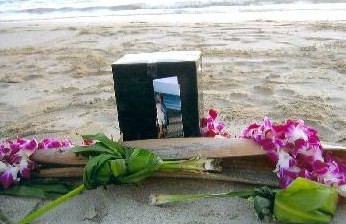
On board the Alala with Lester, Lei’ohu, Maydeen, ‘ohana (family), loving friends, and a most thoughtful crew:
On June 28 ,the 62 foot catamaran Alala—which means blackbird in Hawaiian, sailed out of the marina to the bay where we had spent countless hours, days and years swimming with Dad—perhaps one of his favorite things to do! Following Lei’ohu’s lead, with the Mauna Kea Beach Hotel in sight we offered our “pule” (prayers) and “oli” (chants) to the divine so that Lester would have a gentle journey. Danny, a surfer and beach friend from the hotel, paddled out as we made our “makana” gifts or “ho’okupu” offering with “ki-ti” leaves and personal prayer. We invited the spirit of aloha, light and peace into the celebration of his life as we threw plumeria into the sea and then his ashes. The Alala circled three times around our beloved. We even said the Jewish mourner’s prayer, the kaddish! And then we jumped and swam in the waters where the grainy, gray remains had momentarily floated and then slowly, softly dissolved into the sea. We cried, wailed, laughed, and meditated; we marveled at the sensation of being in the place and in a way and alongside that and whom Lester loved.
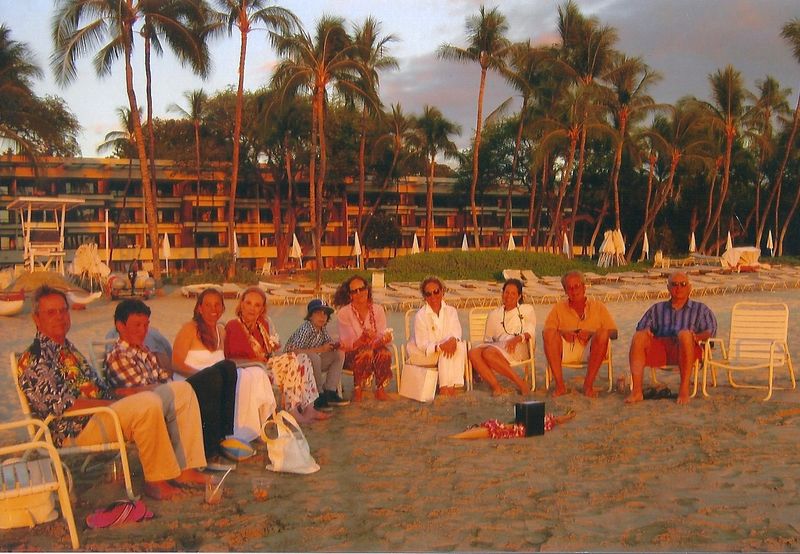
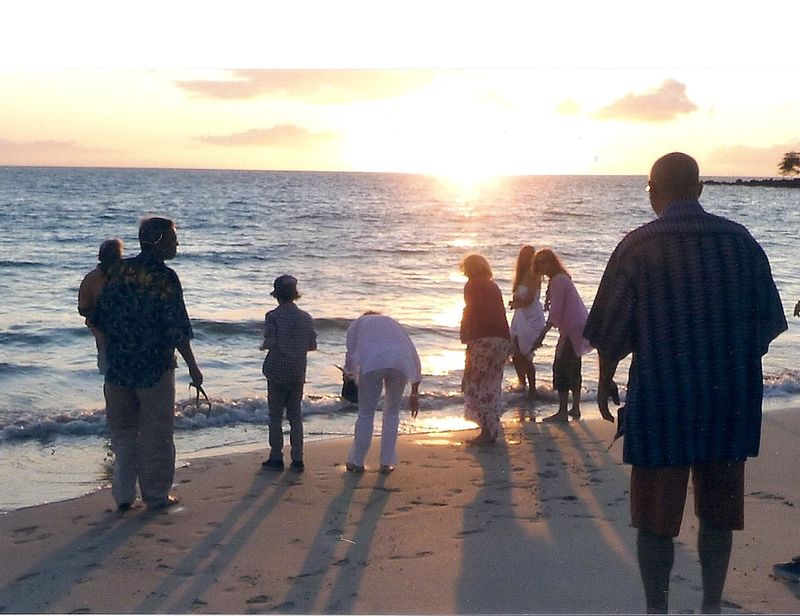
A few days later we offered blossoms and reverence at the shoreline when the last drop of sunlight touched the horizon. We cheered at the green “flash”—once again calling upon a memory of Dad who liked to point and watch it at the end of a perfect beach day.
As Lei’ohu said, “The ceremony for Lester was scripted by him in the heavens as the angelic realms and the divine orchestrated the pathway… “ . It is true and it was so natural.
A dear friend who has volunteered at a bereavement center has learned many things about the grieving process and the rituals one takes to perhaps more tolerably endure grief. She has assured me that the “send off” for my father was “classic text book” and complete in its ritual. It feels pretty complete. I humbly acknowledge the satisfying personal experiences the Jewish traditions as well as the “Hawaiian way of Hali’a” have supported me through this time of grief. I cherish the written and verbal support others have shared with my family and me. I am grateful for all those people being there for me, my family, and for Lester. Yes, I grieve and miss him, and I miss his very own personal version of “Lester” fatherly love. This love can never be replaced, but I am slowly filling up with a new kind of love which is leaving me peaceful and renewed. Namaste.……
I am not there I do not sleep, I am a thousand winds that blow, I am the diamond glints on the snow, I am the sunlight on ripened grain, I am the gentle autumn rain, when you awaken in the morning hush, I am the swift uplifting rush, of quiet birds in circled flight, I am the soft stars that shine at night, do not stand at my grave and cry, I am not there I did not die…
Anonymous Irish poet
 MY MUSE
Leave a comment