

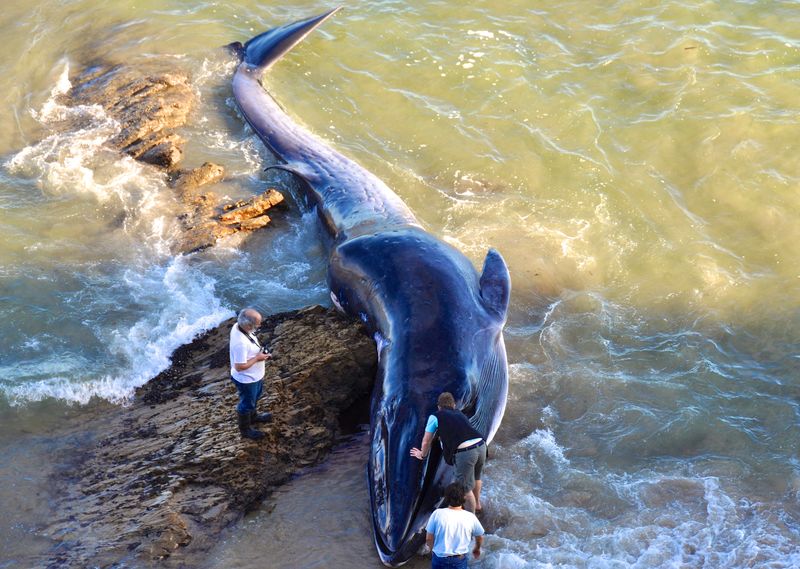
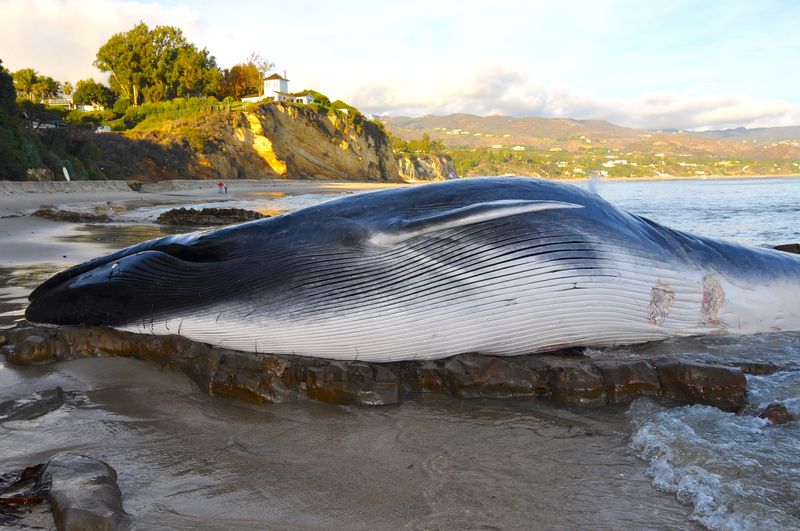
Photographs by Julie Ellerton
ADDENDUM THOUGHTS AND STUNNING PHOTOS OF THE WHALE
Julie Ellerton, a photo-journalist from Malibu, spent several hours with the whale. Her stunning photographs capture for me the poignancy of the whale’s magnificence and fragility, two seemingly opposing descriptions and yet the poetic essence of what nature’s gifts can be. What we purposefully did not include are images of children who climbed the whale’s carcass, as if it wee a jungle gym. Nor did we include the images of the hackers who took their knives to the whale’s surface– hunting for bones and meat. The image here offers the viewer and reader a chance to see the whale, bruised but intact. The photo can provide a proper closing for the whale while it lay between a simple sad but inevitable death, and before the accost which ultimately provided entertainment for some, and bureaucratic posturing for others. This is as close to how we might have seen it as it should be seen– alive and well under the surface of the sea. Thank you Julie for sharing your photos. NAMASTE.
A WHALE OF A TIME
The
mammal had come in with the tide six days prior, reportedly disabled and
injured from an apparent hit on its back, causing a bruised spine. Not a
surprise, I thought, since smugglers and pangas in various sizes had been patrolling. One might have hit the creature, and run. A hit
and run. It seems to me it’s up to the state to address smugglers along the
California coast who might be guilty of such a heinous crime. A crime that takes
place in the waters where cetaceans have made a bi-annual migration for centuries. Waters bearing “sea life” to coves such as the one at the end of my street.
Last
I saw the dead 40-foot blue fin whale was on Saturday, the 8th. A dim December afternoon light merged a milky background of sky and sea; in the foreground the creature was decomposed in a
wretched heap. From the cliff atop the short palisade the stench of the carcass
held steady. Below, a small crowd of some twenty or so had gathered outside the
roped off remains while inside the bone
thieves wielded their long knives and machetes—hacking, tearing,
disrespecting. Waving their tools, and
hacking at the decayed flesh: answering
questions of the crowd as though they were just friendly shoppers. Multitasking and without pause they carved
away the flesh, and dug out valuable pieces of bone: potential loot and profit
for them; satisfying for the “curious” and the “collector, a story as old as
whales and man, a rather cruel, vicious and archaic one. Was this for real? In
my crib called Malibu?
Earlier
in the week you could smell the meaty rot of the whale combined with pungent
salty brine waft down the street that leads to the cliff where I now stood. I
had stayed away when I heard from a neighbor the whale was still showing signs
of life, its fluke raising and falling with the tidal rhythms. I couldn’t bear that, and I cowardly watched
the creature’s fate from the computer. Now that I was there I didn’t recognize any of the onlookers below as my
neighbors. A dying, now dead, whale had become a lurid attraction for tourists,
and a treasure chest for ocean grave robbers.
The
reason I didn’t see my neighbors is because they were home frantically sending emails
to raise money to pay a private boat company to remove the remains of the still
whale and return it to its natural habitat. Forty-five minutes after I left
this horrid view the boat came to take the offal away. I was told it would be
carried some 15 miles out—away from the current—to be returned to its natural
habitat and the natural cycle of the food chain.
Speaking of food chain, isn’t it up to
the state officials or local agencies to address the potential sanitation and
safety challenges a decomposing whale leaves behind? It is common knowledge that whale
oil is an “e-ticket” shark attraction.
Maybe the folks at city hall will worry about that when the millions of
ocean going tourists who pass thru Malibu each year (providing much needed
revenue) become “chum.”
While a discussion was underway,
there was seemingly no negotiation between the public officials or agencies about
an honorable removal of the whale from our beach. Not even in the face of international
news. What wasn’t clear to the state, or
any other local agency is exactly on whose territory (i.e. jurisdiction) the whale
lay. Was its deathbed on private sand,
or in fact, public? A timeless and
constant discourse for California coastal huggers. Low tide or high tide? Where does the public
line meet the private? (The bureaucrats need only to turn to the paparazzi to
know for sure!).
Despite
the lack of bureaucratic resolve, it was the locals, the villagers,
neighbors who altered this depressing picture. Demonstrating community
spirit, humanitarian resolve and leadership, concepts our elected officials
just couldn’t grasp, it was Point Dume residents who hired a boat to take the
blue fin home. I honor these folks who showed heart and conscience. Thank you.
Is
this a “whale of a tale” to rival “Moby Dick”? Hardly, but bone thieves,
bureaucrats, smugglers and beach rights… all addressed in the wake of a broken
creature. An age-old kind of a story in a contemporary setting: it is
compelling and tragic, and unfortunately true. But I do like the ending: a communal
“clan” that sets an example for others, leaving an indelible “positive” mark in
the sand.
SNEAK PREVIEW FOR NEXT POST:
AN ARTIST’S VOYEURAMA
 MY MUSE
Leave a comment