

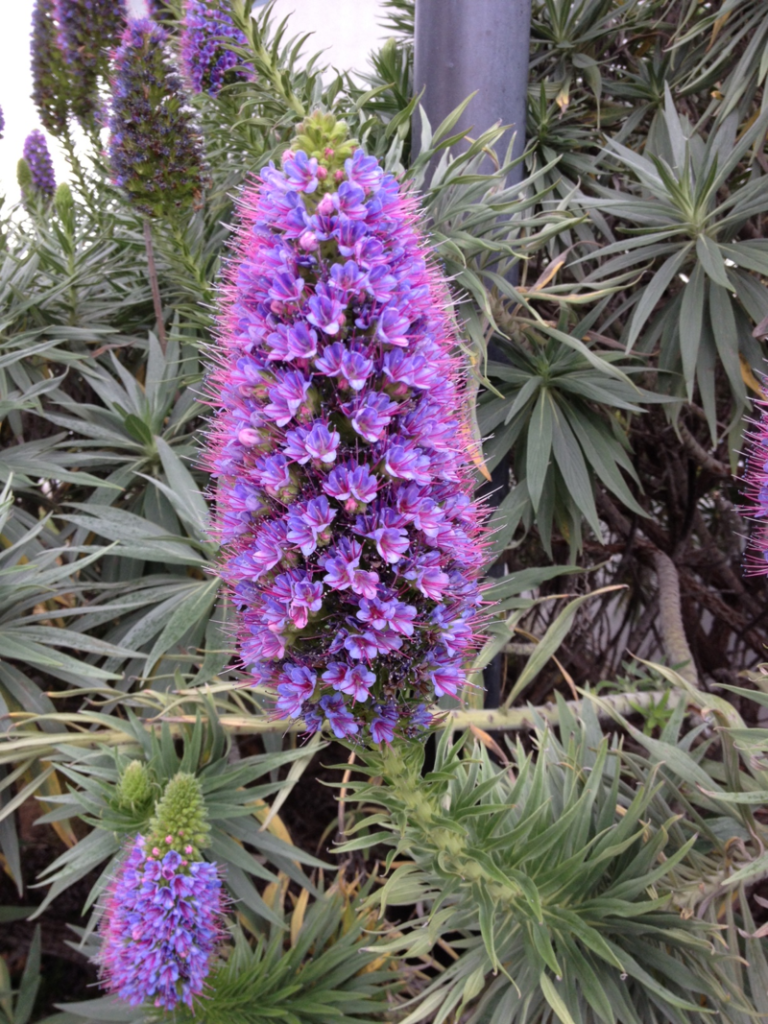
The deliriously blue-purple
conical shaped flowers you see shimmering along our arid coastline every Spring
is the Pride of Madeira. I like to call it the Pride of Malibu. Its’ botanical
name is Echium candicans which sounds like “eating candy” to
me. Don’t try to eat it. From a distance this biennial
subshrub looks fuzzy
and soft, but in fact it is quite a defensive plant with taut spikes that jut
outward from the cob at its core. Look closely, and imagine as I do
a Chopard bracelet made up of rows and rows of saphire and amethyst florets.
Nature’s jewels. And attract, it does.
I leave this borage to the butterflies and bees to
contently hum and flutter about the bright dome heads when in bloom. Let
them eat cake! So beautiful are these freaky flowers, you might want to handle
their “clusters.” Warning! Do not touch without gloves, lest nature’s beauty
will bite back causing serious skin chafing and allergic reactions.
At the instant I photographed this Pride of
Madeira with my iphone, its beacon of color filled me with the anticipation of
Spring. Even now I marvel at the way the light upon the flower creates an
illusion that light radiates from its interior.
The Pride of Madeira is a native plant that
originates from an island of the same name off the coast of Portugal, near
Morocco. Madeira means wood in Spanish, which makes sense since the island once
had vast forests.
By sheer coincidence I recently rediscovered a
book in my personal library called, “The Flowers and Gardens of Madeira”
(publishers Adam and Charles Black, 1909), illustrated and written by Ella and
Florence Du-Cane. The book evokes a genteel moment in time when a pair of
traveling women might have found a freedom of expression in the writings and
artistic considerations of private, walled, and public gardens. Ella’s pen, ink
and watercolor paintings are charming studies of flowers in-situ: fountains,
pathways, terraces and cliff sights, all stunning in detail, color and
composition. Along with Florence’s in depth descriptions and historic
references, the Du-Canes fulfill an image of a one time Mediterranean paradise,
and a more romantic era.
Writes Florence: “Lovers of flowers—and to those
I most recommend a visit to the island—will find fresh beauties even at every
turn of the street…”.
Now an antique, the illustrations and colorful
narrative in “The Flowers and Gardens of Madeira” brings to minds eye the end
of the “Gilded Age,” and perhaps a scene executed by the master
watercolorist himself John Singer Sargeant. The painting would feature the
sisters Du-Cane in ankle length dresses under parasols, one with a sketchpad, the
other taking notes. At the plaza water fountain, arm in arm on a cobbled road,
or perhaps sharing tea with Edith Wharton and Henry James in the shade of a
villa garden by a wall dripping in brick red Bougainvillea spectabile.
Madeira, 37 miles in length and 14 miles wide,
impressively possesses topographical characteristics of both California’s North
and South. Because of its high elevations and peaks, Madeira boasts a sub
tropic climate such as that of Northern California. In fact, the Du-Cane’s
describle Madeira’s 6000 foot peaks as a “miniature” landscape, and similar to
the “grandeur to that of the Yosemite Valley.”
Meanwhile, Madeira’s proximity to Africa lends a
dry climate similar to Southern California’s arid landscape. And while we
suffer the Santa Anas, Madeira, like its southern European neighbors, bears the
“Leste,” a hot south Eastern wind blowing from the Sahara. It’s no wonder we
have so many of the same plant varieties, to wit, the Datoura (and deadly!)
trumpets; the ethereal Jacaranda buds that carpet our streets in June;
December’s holiday-ish Flamboyants, better known as Poinsettias; the ever
charismatic Purple Bougainvillea “creeper” that subsumes our porticos. And for
a brief period each Spring, the brave and the bold purplish-blue Pride of
Madeira.
I photographed my Echium Candicans outside
Malibu’s City Hall in early March, which was premature for Malibu’s Pride of
Madeira season. I have to guess its “bolting” was attributed to the “false Spring”.
I had never noticed this plant in that location
adjacent to a parking lot I use weekly. Cars can bump it and it will bump right
back. After all, it is hardy and strong and has evolved to withstand
headwinds on the cliffs at coastlines. I wonder: did the City of Malibu plant
seeds here, or replant an existing plant? Or maybe they built around it? Any
way you look at it the Madeira was in Malibu long before any concrete was.
Picture this: As Juan Rodriguez Cabrillo leaves
the Bay of Funchal in Madeira, Portugal he plunks some Edium Candicans seeds in
his uniform pouch. When he gets to the land of the Chumash on the Baja coast in
1543, he is mesmerized by its’ natural beauty, and embraces the vista that so
resembles his homeland. As he makes his way to a higher ground hoping to get a
better view of the lagoon, Cabrillo grabs at chaparral to secure his footing.
As he reaches for the wild grass, the seeds from the purple flowers of Madeira
fall from his pouch, into the poor, clay soil. As Cabrillo climbs uphill, the
soles of his thick leather boots bury the seeds, for good.
 MY MUSE
Leave a comment