

California Typewriter: A Place, A Movie, A Vibe.
It’s not often that we actually get off the farm, meaning the vineyard, and when we do it’s usually a case of “valley fever.” But not this time.
We were inspired by the movie, so we went to see the place. And then we touched the keys.
At the suggestion of our friends we watched the documentary California Typewriter directed by Doug Nichol in which, among others, Tom Hanks and John Mayer describe the seductions and attributes of the typewriter. That was a Monday night. On Wednesday we made the hour and ten-minute drive, a journey of some 50 miles, to San Pablo Street in Berkeley. I hadn’t been to the college town since 1975 when I spent my freshman year at Cal. Both my father and uncle had graduated from there, and I had convinced myself it was my destiny to go there. Wrong! I was like a square trying to fit into a circle. The school, the town, just didn’t fit, but then not much did as I was turning eighteen.
We found a parking place right in front of California Typewriter at 11:45 am, fifteen minutes before opening time, and so we ran across to Alfonso’s next to the body shop for a cup of Joe.
Couldn’t say if it was the caffeine or the vibe of California Typewriter that got my heart racing. My guess was the latter. There was something about strolling into a place where the leaves have blown from the sidewalk across a worn threshold and into a room that boasts the subtle aroma of ink and time. There’s the linoleum counter top, behind which proudly sits a wooden card catalogue with a set of drawers that houses the names of clients: maybe the likes of David Mc Cullogh who is featured in the movie, or perhaps the Cal student who was leaving, or picking up, one of fourteen typewriters she owns. Somewhere in the back, out of sight is the place of sacred repair. The hospital of keys, the surgical center of the thing that came before the computer.
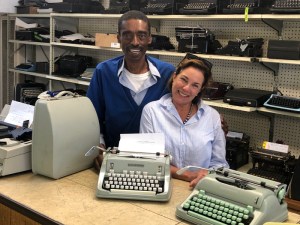
Carmen was there to greet us, and we chatted like old neighbors. She was ready to talk shop, the movie, and the machine that might best fit our chops. Nothing pushy about it, just the facts.
Excitedly I tried out a Brother, an Underwood, the Remingtons and the Royals, all of which were lined up side by side on rows of shelves. I banged at the keys and hammered Carmen with questions, no one skipping a beat.
Ken strolled in and I just about fainted. From behind the counter, in the recognizable sandy voice from the movie, he said “Good afternoon.” The Doctor himself, I thought and he smiled at me on his way to the mysterious clinic in the back where hundreds of machines were waiting for him.
Returning to the lessons at hand I studied a typewriter dating back to 1904, and a skeletal apparatus designed for the blind. Then back to the shelves to revisit the Brother from the 60’s. Gee, I thought, I want to take it home. It was nostalgic: remembering a summer school session when Dad made me take Typing I & II, taught by Miss Brooks. It was the joinder of the mental and physical, an exercise in using the strength and reach of fingers. It was an unadulterated desire to hear the slugs hit the paper and the satisfaction of hearing the clicking of the roller as the paper slides across the platen. Nothing electronic. Pure mechanics.
When it was time to go I decided owning one of these things was something to think about. Just before walking out the door I noticed an elegant typewriter on the counter. I grabbed a random piece of used pink stationery and typed my name.
Woah! For real? The font is in script. I type some more, my fingers effortlessly gliding over the keys. I get lost in the motion and feel like I am dropping into a meditation. It’s groovy and nearly transcendental.
What was this machine? An Hermes (rhymes with worms) 3000 made in Switzerland.
“Solid. Made by a company called Paillard. Not the same as the fashion people,” Ken said, his smile ever broadening. “That’s a nice one. The Swiss knew how to make an efficient machine. Needs a tune up, though. And, it belongs to her,” he added, nodding his head towards the student and owner of some fourteen typewriters, four of which were there for repair. Knowingly, she smiles and slides the machine towards her.
“I use this one to warm up, before I do my real writing,” she says. “It’s like a meditation,” I blink at this groovy connection.
I just had to get my hands on a Hermes 3000, Suisse. Not the clothing line, but still a “messenger to the Gods.”
Once home I returned to my computer where I learned about Paillard-Bolex, a company that made music boxes before making record players. Later they would make radios, then cameras and calculators. I called Carmen. “Yes,” she tells me, “we have two in the back. One from the 50’s, and one from the 60’s. Both in good condition.” That was Thursday.
Friday morning, San Pablo Street. My match was awaiting me: a 1968 the iconic gray-green (the color of my favorite French walls) with softly shaped, cream colored keys. The Hermes 3000 square top would surely stand on its own in my writing room. Offering up an elegant script, along with a reliably firm platen, satisfying clickity roller and easy ribbon release mechanism, this was the perfect fit.
 MY MUSE
Leave a comment