

I Can See Myself In That Chicken (Inside A Small Box)
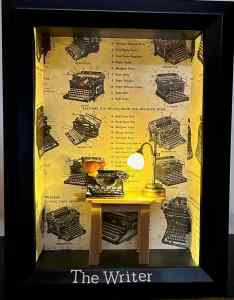
For me, “The Writer” is a simple case of transference: I can see myself in that chicken. There I am, at the writer’s desk, poised at the typewriter, surrounded by a wallpaper of swirling words. “Cluck-cluck!” I hear myself say, “I am that chicken.” And so dear reader, despite the proverbial “chicken” that I am to share my musings, I continue to peck away. (Small box: Once Upon A Storytime).
I am besotted by a chicken. Not a tasty Tajine, nor a crispy splayed Spatchcock, as food is what usually captures my attention. In this iteration I am enchanted by “The Writer”, a “Once Upon A Storybox” tableau originally created by my forever bestie, Carey.
Charming and unique this particular 5”x 4”x 2” Bienventura Semilla Cubana cigar box redux is cobbled together by cardboard, tape, nails, and sealing wax. Revealed through a sheet of plexiglass is the prize within a small plasticky chicken sitting atop a mini- typewriter which sits alongside a lamp, and a pencil with an eraser, (rewrite, rewrite). All of which rest upon a mini popsicle stick table.
Not all “Once Upon A Storybox” tableaux feature miniatures; regulars are sized at 7”x 9”. But the principals are usually the same: fowl– posed to pick oranges in the orange Ojai sun; astride ironing boards contemplating a basket of laundry; hovering over a kitchen stove. Carey has been known to plant a sheep, lamb, or bovine in her scenarios. N’er a mare nor a stallion. Now and then a pug and a pussy. As a wee lass Carey played for hours with dollhouses, inventing and reinventing real rooms. For her, creating story boxes is a new riff on the same theme. And still small.
How clever is my friend! How clever is her process! First, she selects a scene like a vineyard or French flower shop. Often times she will use images from her husband’s photography archive which she then miniaturizes in Photoshop. Then she glues that background onto cardboard or thin wood. Carey can wire a lamp electrically or with a battery. With a little spit ‘n glue the props get in place and the box comes to life.
Through “The Writer” plexiglass window Remington and Burrough’s typewriters float upon miniature wallpaper. I am reminded of the newsrooms of yore where you might find any ol’ bird with a story to tell.
I check out the chicken who stares back at me as if to say: “What do you think I’m doing? I am writing!”
“Cluck,” I say, “and so am I.”
Exciting News: While “pecking” away– I have been, on my recently published “I’ve Been Thinking.” Stay tuned….
Napa Wash
Most often I am inspired by nature, whether it be visually as an artist, or verbally as a writer.
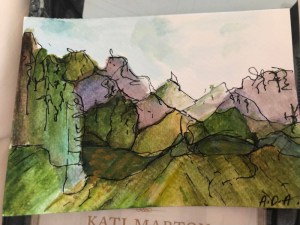
Last summer, with simple watercolors and ink, before the treacherous fire episodes scourged the Napa Valley and its surrounds, with feeble brushes and watered down cakes of paint I painted abstractions of the nearby Mayacamas Mountains and surrounding vineyards, and I attempted to still the sky and its shifting clouds.
As early summer unfolded into a sweltering July this humble act of observation became a daily practice. Without too much self-judgement I eagerly studied and recorded my observations in my studiolo. In fact, the backdrop of my Instagram – @mymusegrams – launch letter is one such recording. What was painted as a horizontal rendering of the hills outside my house turned vertical now looks like the California coastline.
I painted several postcard sized landscapes before the devastating Glass Fire episodes drove us out of the valley. Luckily our house and vineyards were saved. I also thought it fortunate that of all the summers this was the one where I painted those verdant hills as much as I had before so much of it burned.
Nature holds a powerful pull for me, like a spell I fall into its rhythmic fold. In my attempt to record or even mirror the experience of nature, I try to permanently hold onto it within myself. So much for the struggle of the millennium and all humankind! The challenge to meet nature’s poignancy is rarely satisfied however reliably engaging it may be.
Nature is the best starter fluid for my writing practice.
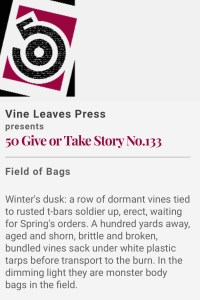
Publisher “Vine Leaves Press” recently posted in its column aptly titled, “50 Give or Take,” three of my Flash Fiction pieces. You could call them poems if you like. Funny coincidence, though, the reference to a vineyard! Or is it? Anyway, the column calls to express as much as one can with a limited number of words. I love trying my hand at it and making the most of my experiences in the vineyard, in the garden, with the dog… and so much that nature wrought.
Please, take a read…


Sexy Knife
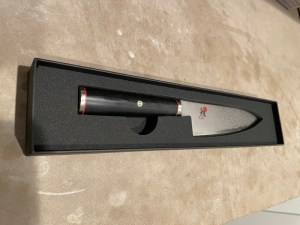
The Miyabi Kaizen 5000 DP, 34183-163 is my new favorite dinner date. Even these obsequious i.d. numbers are sexy to me now. While this 6” chef’s knife’s sliding, gliding micro carbonate steel blade and sleek handle has been sitting quietly in its encased bed for months waiting for the chef de la maison to withdraw it from its foamy sheath, I thought it verboten for me, merely the sous, to take advantage of its thrills.
You probably know the benefits of Japanese knives, or possibly their Samurai weapon qualities, and therefore you can appreciate their spectacular reputation. You probably know the delicacy with which you must manage them, and certainly, clean them. Until now, I did not, mostly because I was not interested in the knife as a medium, or a tool, and thus something to enhance the artform that cooking can be.
In our household, I am not the great chef, nor even a good cook, but I am a patient slicer, dicer and an even julienner; the vegetable is my game. The veggie provides the luminous color and a healthy, and on most any day delicious roughage filler in our diet. That is why I am touting the Miyabi 34183. Oh sure, there’s a whole line of them out there, Miyabi’s, and Shuns, but lest I repeat myself, the crying onion, the clever shallot, the Hermes orange carrot, the tumescent cucumber and even the crowning ruby cabbage has never responded to a knife like this, at least not in my humble kitchen.
Naturally, during this time of Covid, quarantine and curfews, when we can’t go out to satisfy our discriminating hungers, those of us who appreciate good and fresh food must step up to the chopping block. For this reason, and because the chef de la maison has taken an interest in more plebian affairs, like the future of world order, I have been indirectly nudged to recognize the Miyabi 34183 pressing against the slotted knife holder (still in its box!) deep inside the kitchen drawer. Perhaps it was because I re-watched Julie and Julia on Thanksgiving, and secretly wondered if I could stuff a duck. In truth, I can’t recall. Oh well, the point is, I have been lured to the blank canvas that is the cutting board, seduced by the subtle curve of the well-fitted composite handle, a stealth of a blade, and the familiar ease that feels like an old friend.
During these challenging times you might want to drive this Japanese knife into the heart of your mattress, or dig out the grit from under your fingernails, but do not. Instead, why not try, a new “old” recipe, like the one I’ve listed below which comes from an old cookbook that belonged to my late in-laws who were deft cooks. You’ll only need the one knife, the only one and true. (Feel free to replace the chicken fat with butter!).
(From Luchow’s German Cookbook)
Red Cabbage With Apples
Rot Kraut Mit Appeln
1 medium-size head red cabbage
2 apples
2 tablespoons chicken fat
1 medium-size onion, sliced
1 quart of water
1/2 cup light red vinegar (or a bit of red wine)
1/2 cup of sugar (I use brown sugar)
1/2 teaspoon salt
1/4 teaspoon pepper
2 cloves
1 bay leaf
Juice 1/2 lemon
Wash cabbage, drain; cut as for Cole Slaw
Wash and core apples;peel and cut in small pieces.
Heat chicken fat in large saucepan and saute onion and apples 3 0r 4 minutes. Add water, vinegar, sugar, salt, pepper, cloves, bay leaf, and lemon juice. Stir;bring to boil. Add cabbage. Cover and let simmer 45 minutes or until tender. Just before serving, (you can) sprinkle flour on top to absorb liquid. Serves 4
Thank you Mask Man
“Thank you Mask Man” –Lenny Bruce
My husband had shoulder surgery the day Los Angeles began voluntarily donning the ubiquitous mask.
Sixteen weeks later he looked up from the Off -Duty section of the Wall Street Journal and announced he wanted a different kind of droplet protector. “This says twenty-five dollars for the less expensive, but fashionable mask. That’s ridiculous.”
“Masks are in demand,” I shrugged. We both knew the “mask” had become a utilitarian device essential to warding off the villanous Covid 19. Apparently now we were invited into a new fashion trend. But we so disliked the term mask because it evokes fear and hiding, a feeling and action proving to be all too true! We resorted to calling our masks the “thingies.”
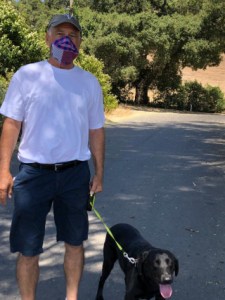
“Forget it,” said my spouse slamming down the paper. “I’m not paying for that.” I watched as he picked up a fresh disposable blue and white thingie, and left the house to take the dog for a walk. By this point we would be penalized by the county if strolling without a thingie. Despite all the up close and personal sidewalk action that takes place in West Hollywood, Ella the Labrador refused to wear one.
I thought deep and hard about my husband’s state of being. I could tell he really wanted a cool thingie. That afternoon I went non-digitally shopping to one of my favorite haunts.
The store is near WE HO, very convenient. It quietly shouts chic in a way that says: fabric that breathes matters, shape for comfort matters, and an ample selection for a variety of shapes, matter. I thought here, would be imminently promising for some great masks. The air-conditioned space felt like a sophisticated SOHO art gallery wearing my own disposable thingie.
“Hi,” says the lovely sales associate who had helped me the last time I was there shopping. “How is your husband feeling after the shoulder surgery?”
“You recognize me with my thingie on?” I ask pointing to my face, as if I had to. Her pale green eyes shone above hers.
“Of course. You were here the day of his surgery.”
I thanked her for her inquiry.
“I’m here to buy a mask for him. He’s been so good.” It was true. He had bravely slogged thru the pain of the cut into the meaty part of his shoulder, followed by the painful physical therapy exercises. Only of late had he been able to work out with a conscientous trainer who exposes him to intermittent, but healing pain. If not a pretty mask, for months my spouse has been wearing a handsome badge of courage.
“Of course,” she said, and with six feet apart we strolled over to the mask table where a gentleman wearing blue rubber gloves was pricing the pieces. Would they would cost more than what I was hoping to pay?
“Twenty,” said the man behind a fashion statement that loudly sang in a cacophony of colors.
“Bingo,” I thought while deeply breathing in my own CO2. Certainly, I had come to the right place. Now to narrow it down. Within my own cloud of suffocation, I studied the inventory. Purple with checks, green with amber florets, on and on and deeper and deeper I swam into swirling polychromatic patterns.
Not sure of how much time had passed I finally felt as if I were coming out of an induced viral fog. And I knew what to do.
I imagined which mask my husband would wear if it were a bow-tie.
Call it his St. Louis roots, a leftover of his unfailing midwestern sensibility, he has held onto a drawer-full of this tidy-winged cravat born accessory. He loves them. We may never go anywhere again but he still has a drawer-full, just in case we might one day.
“I’ll take that one,” I pointed, ever so pleased with my keen method of deduction and selection. With great immediacy and swift action, I selected a mask as if it were a bow-tie. It was as if the mask had spoken to me, for him, from behind which he would be speaking.
“Of course,” said my new favorite sales associate in this entire sickly world.
Within moments I was on the sidewalk, alone, gulping the oxygen available to me. I felt buoyant, for tight within my grip was a neat bag inside which was a gorgeous mask that brings to mind a symphony of cheerful possibility.
“Wow,” my husband said when he removed the mask from the bag. “Neato. I love it.”
That’s quite a statement from someone as subdued as he. He poofed it open, placed it over his nose and mouth, fastened the ties around the back of his head and took the Ella for a walk. Again. no thingie for her. They looked adorable sauntering down the sidewalk. She all in black, but for her orange collar, he in gray, but for his pinkish, purplish, and striped mid-night blue thingie. Thank you, mask man.
California Typewriter: A Place, A Movie, A Vibe.
California Typewriter: A Place, A Movie, A Vibe.
It’s not often that we actually get off the farm, meaning the vineyard, and when we do it’s usually a case of “valley fever.” But not this time.
We were inspired by the movie, so we went to see the place. And then we touched the keys.
At the suggestion of our friends we watched the documentary California Typewriter directed by Doug Nichol in which, among others, Tom Hanks and John Mayer describe the seductions and attributes of the typewriter. That was a Monday night. On Wednesday we made the hour and ten-minute drive, a journey of some 50 miles, to San Pablo Street in Berkeley. I hadn’t been to the college town since 1975 when I spent my freshman year at Cal. Both my father and uncle had graduated from there, and I had convinced myself it was my destiny to go there. Wrong! I was like a square trying to fit into a circle. The school, the town, just didn’t fit, but then not much did as I was turning eighteen.
We found a parking place right in front of California Typewriter at 11:45 am, fifteen minutes before opening time, and so we ran across to Alfonso’s next to the body shop for a cup of Joe.
Couldn’t say if it was the caffeine or the vibe of California Typewriter that got my heart racing. My guess was the latter. There was something about strolling into a place where the leaves have blown from the sidewalk across a worn threshold and into a room that boasts the subtle aroma of ink and time. There’s the linoleum counter top, behind which proudly sits a wooden card catalogue with a set of drawers that houses the names of clients: maybe the likes of David Mc Cullogh who is featured in the movie, or perhaps the Cal student who was leaving, or picking up, one of fourteen typewriters she owns. Somewhere in the back, out of sight is the place of sacred repair. The hospital of keys, the surgical center of the thing that came before the computer.
Carmen was there to greet us, and we chatted like old neighbors. She was ready to talk shop, the movie, and the machine that might best fit our chops. Nothing pushy about it, just the facts.
Excitedly I tried out a Brother, an Underwood, the Remingtons and the Royals, all of which were lined up side by side on rows of shelves. I banged at the keys and hammered Carmen with questions, no one skipping a beat.
Ken strolled in and I just about fainted. From behind the counter, in the recognizable sandy voice from the movie, he said “Good afternoon.” The Doctor himself, I thought and he smiled at me on his way to the mysterious clinic in the back where hundreds of machines were waiting for him.
Returning to the lessons at hand I studied a typewriter dating back to 1904, and a skeletal apparatus designed for the blind. Then back to the shelves to revisit the Brother from the 60’s. Gee, I thought, I want to take it home. It was nostalgic: remembering a summer school session when Dad made me take Typing I & II, taught by Miss Brooks. It was the joinder of the mental and physical, an exercise in using the strength and reach of fingers. It was an unadulterated desire to hear the slugs hit the paper and the satisfaction of hearing the clicking of the roller as the paper slides across the platen. Nothing electronic. Pure mechanics.
When it was time to go I decided owning one of these things was something to think about. Just before walking out the door I noticed an elegant typewriter on the counter. I grabbed a random piece of used pink stationery and typed my name.
Woah! For real? The font is in script. I type some more, my fingers effortlessly gliding over the keys. I get lost in the motion and feel like I am dropping into a meditation. It’s groovy and nearly transcendental.
What was this machine? An Hermes (rhymes with worms) 3000 made in Switzerland.
“Solid. Made by a company called Paillard. Not the same as the fashion people,” Ken said, his smile ever broadening. “That’s a nice one. The Swiss knew how to make an efficient machine. Needs a tune up, though. And, it belongs to her,” he added, nodding his head towards the student and owner of some fourteen typewriters, four of which were there for repair. Knowingly, she smiles and slides the machine towards her.
“I use this one to warm up, before I do my real writing,” she says. “It’s like a meditation,” I blink at this groovy connection.
I just had to get my hands on a Hermes 3000, Suisse. Not the clothing line, but still a “messenger to the Gods.”
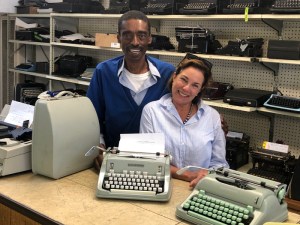
Once home I returned to my computer where I learned about Paillard-Bolex, a company that made music boxes before making record players. Later they would make radios, then cameras and calculators. I called Carmen. “Yes,” she tells me, “we have two in the back. One from the 50’s, and one from the 60’s. Both in good condition.” That was Thursday.
Friday morning, San Pablo Street. My match was awaiting me: a 1968 the iconic gray-green (the color of my favorite French walls) with softly shaped, cream colored keys. The Hermes 3000 square top would surely stand on its own in my writing room. Offering up an elegant script, along with a reliably firm platen, satisfying clickity roller and easy ribbon release mechanism, this was the perfect fit.
Miracle Mattress
THE MIRACLE MATTRESS
My friend Mary mentioned she needed a new mattress. It just so happened I was getting rid of mine. “It’s too hard,” I told her. “Take it.” Ten days later Mary borrowed a truck and drove 350 miles to the Bay Area to pick it up.”
Looking like a gigantic piece of spongy tofu wrapped in a triple ply plastic, the 200-pound mattress leaned against the dusty wall of our garage. It was the kind of bedding meant to endure the thrash of environmental threats, and my spine could never get used to its stubborn resistance. It took two women and two men to lift the Cal King onto a GMC 4×4, a truck twice the size of my husband’s 22 -year old 150 Harley Ford. “His truck is a baby next to this one,” Mary said hoisting herself into the driver’s seat.
The mattress now roped to the insides of the truck bed seems secure. “Stay safe,” I say, and wave as she heads down the gravel driveway, a six, maybe eight- hour drive ahead of her, back to Los Angeles, depending upon the density of interstate clog.
Two hours later I get the call.
“Where are you?” is my worried greeting.
“I’m in Livermore on the 580. The mattress flew off the truck. It took air and I didn’t even know it.”
It’s clear she’s panicked. I try to imagine the mattress as a surfboard, skateboard, or, snowboard. It’s tough. “Where is it?”
“It’s back there, somewhere. I don’t know.”
“What’s your plan?” I ask, calculating the possibilities in my head. The mattress is mangled by now, hit and pummeled and shredded. Or it is charging at a Mini Cooper like a wall that’s come undone. No matter how I weigh it, the mattress trade-off isn’t going as planned. The whole deal is turning into a nightmare.
“I’m going back,” she says, “I have to try to get it. God forbid it’s causing wreckage.”
You go, girl, I want to say, but she’s already hung up. I begin to text.“When you get there, don’t call the police, call roadside service. Triple-A.” I wait for a response but there’s nothing. Good, I think, she is focused. And in my mind’s eye, I see Mary exiting the southbound 580, whipping around in her 4×4 to get onto the northbound.
Six minutes later she calls.
“I’m here with the mattress,” she shrieks above the cacophony of cars whizzing by in the background. “You’ll never believe this,” she’s still shrieking. “Two girls are getting back in their car—they just pulled the mattress to the shoulder side of the fast lane.”
“What?” I imagine two slight, female forms emerging from a Prius, fleece wings tumbling from their delicate shoulders to their waists, and in one motion swooping down to lift the spongy mass and effortlessly delivering it to the side of the interstate. “Mary,” I tell her in my loudest confessional voice. “I can’t believe people are really that nice.” But she doesn’t hear me.
“They’re waving at me now,” she continues, “ … now they’re driving away! That’s it! They’re gone. And the mattress is here, still in the bag. The plastic is intact!”
Now she’s balling into the phone and elephant tears coming from nowhere run down my cheeks. I can’t get my head around this. Whatever, we don’t have time to get philosophical.
“Oh my gosh,” she screams. “A cop. A cop is pulling over. I’ll text you.” I tremble at the thought. Would she be in trouble, or would he help? The phone vibrates three minutes later.
“Hello,” I try to sound calm but I notice my greeting sounds more like a bark.
“He helped me put it back on the truck and we strapped it down. He wasn’t mad but just said, ‘have to get this off the highway’ and then he split. I can’t believe I did this…”
“Mary!” Now I am sure I am barking. “This is a miracle! The cop, the girls.”
“It is?” She blows her nose into the phone while I’m wiping my face on my sleeve.
“Those girls were amazing. I don’t know what I would have done…”
I don’t either, but I am grateful and feel relief.
“Text me when you get home,” I tell her.
“Okay,” she says, sounding more together. “Okay, here I go. Again. Okay, wish me luck.”
I do, but I hope she doesn’t need it, or if this was all a bunch of luck, it hasn’t run out.
Seven hours later I get the text.
“A neighbor helped me get it into my apartment. Believe me, I’m ready for bed.”
Thank goodness I think, and consider texting her to review the day’s events. Instead I emoji a happy face with a kiss, and trust that she is already fast asleep, having a darned good dream.
Clouds, Both Sides, Now
September 18, 2017
St. Helena, CA
As daylight breaks I wake up to the sounds of the harvest morning.
“Hurry, hurry, rapidamente ahora, move, now.” Yells the stranger’s voice. Visible through my bedroom drapes a row of men hunch over the vines, hoodies hide their faces.
I quickly dress to the beat of the annual pick: fruit into bins; thump goes to bump: thump to bump, bump bumping of bins push pushing against each other: “Hurry, cut, bump-thunk, thunk-cut,” wanes the refrain.
Like a sleek black shadow our three -year old “wine dog” scurries the dirt paths and skirts the workers. Her male human, my husband, hovers over the vines with the rest: hook knife in one hand he slices a grape bunch off its stem, and with the other he catches the turgid fruit before releasing it into a bin. Since yesterday the valley air has hung heavy with the must of grapes. Today the perfumed residue mingles with dirt and dust. Above, pink, silver and opal clouds wisp like shredded silk.
I snap this celebration with my iPhone and send the images to something called the iCloud, as if I even know where that is. No matter: in my excitement to share this vivid I tap into my text “A-list”.
There they are, my sisters’ names.
Wait, is this really happening? I panic, erase, and enter only baby sister’s name. Click, and send. Click and send.
Up valley later in the day I am in sivassana after a strenuous yoga class. The favorite teacher of mine possesses a unique ability to softly push the practice so our muscles open softly. So might my heart, I hope, which, like my neck and sacrum is tight, gripping like some kind of a vice.
On my back I gaze thru massive sliding doors that open onto an outdoor garden of succulents. Overhead capacious, shape shifting clouds play like a carousel of forms against the French Blue sky. First an elephant, trunk and all, then a doublet of girls in skirts, then a lighthouse. A lighthouse? Closing my eyes I use its beam to peer into my heart that might open just a crack more than usual. Crying would be easy, but the saudade gets in the way.
Saudade is a word Brazilian people use to express the feeling of longing for something that is missing. Perfect, since Victoria loved everything from that country. A tidal wave of longing drowns me. I am lost in saudade. I desperately want to tell her it is she I miss. I miss you. I miss you.
As soon as I figured things out, about the time I was three years old, Vicki was my most favorite person. Two years younger I followed her around like a pet ferret. I was in love with her. She was my bigger sister who knew so much, everything. She knew when our parents would come to tuck us into bed, and how long we had to lie awake before being allowed to rise after daybreak. She understood what it meant to pet the dogs gently; she knew how to tear the paper sleeve off the Good Humor Bar.
In many ways (certainly later with little sister) we raised each other: bathing each other, massaging Lubriderm onto each other’s backs, standing round the big pink sink waiting for the other to finish brushing her teeth, or waiting for the other to finish peeing in the corner toilet before it was one’s own turn.
In bed at night we listened to the vinyls, memorizing every part. Before little sister was born, we performed the songs, or made up our own bebop sounds on the steps that became a stage to the breakfast room where the adults gathered and clapped.
She was a good big sister. When I was eleven and she was thirteen I begged to be included in her posse; one day she let me tag along (always a few steps behind!) to Morley Drugstore for chewing gum and a coke. She loaned me her Monkees album, and she patiently (and repeatedly because I was not very good at this) taught me complex dance shuffles. Later, we swapped gossip. Always, we swept each other’s paths. Rarely, we fought. When we did, it was usually due to my shameful temper. When we fought we repaired quickly.
Victoria made me laugh harder than anyone. Often, she made me crumple to the floor or jump up and down lest I wet unwillingly. Except for that time in the wilds of Tanzania, when driving on a crude, red clay road, we both had to go. We asked Joshua our driver to stop and told our husbands to go to the front of the open jeep so that we could hide and do our leaky business behind the cab. Where else? There was no place to go and no place to hide. What we didn’t know was that the Go Pro-mini cam was nearby, and caught us crouching and giggling while the dung beetles teased us from their mounds.
We had the rights to finish each other’s sentences, and we possessed the secret language of sister-ship. The Star Sister Ship. We were also members of the Secret (Sister) Society of Pinkies along with Dad. We over tipped at Christmas and loathed snobbery. We pssst at the phonies, and admired the reals. We pretended to be happy when we knew we really weren’t. Keenly, she nodded to the worthiest of causes; repeatedly (and my guess is with much frustration) she reminded me not to judge others, but to put myself in their shoes.
Victoria Leslie did I ever tell you all these things, and more? How much you inspired me?
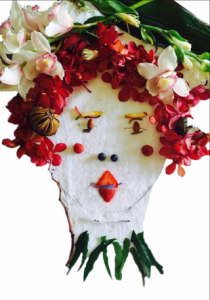
I am not sure I truly told you how much I loved that last time we were in Hawaii, when for my birthday out of a riot of tropical flowers you made a Heronymous Bosch-like-female that I thought it was the prettiest thing ever? (You even got the crossed eye right!) We couldn’t take your brilliant art piece with us, but then, what can we? Hawaii is there, but will never be the same.
Big sister, you are the first member of the Star Sister Ship who too early, but with dignity and valiant bravery, left this lifetime to go way beyond the clouds, a place, a something, a form we earthlings cannot fathom. And I miss you.
Will you read this post? Hopefully: as soon as I press send.
Lolly the Labrador: The Lolly Dalai Lama
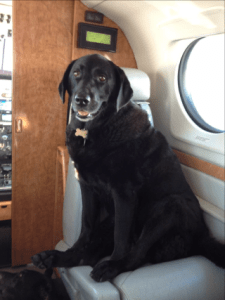
Yesterday I went to the vet to pick up Lolly Brown our Labrador. I said, “Hello, Loll,” the way I have always greeted her and then sang a little ditty I made up years ago. You can hum it however you like, but my tune is somewhere between “Paris in Springtime” and “Happy Birthday.”
Lolly Brown came to town wearing a crown, upside down.
Then I put her on the passenger seat of my car peacefully tucked away in her 9 by 5 inch red cedar box.
She was our Lolly Brown, the Lolly Ba-Ba, the Lolly Dalai Lama, Lollylicious, and many more. She came to us as a puppy when Dad won her at an auction for the Boys and Girls Club and promptly passed her on to us. Her puppy breath smelled sticky sweet and sometimes of roe. Most of her life she, her breath, her corporeality smelled of truffle mousse, mushrooms and steamed baby zucchinis.
Lolly Brown’s namesake was a Louisiana woman with creole roots who raised my older sister and me. Lolly Brown, the human, taught us to sing and dance and be happy little girls. Lolly Brown, the dog, looked over me as well, but for much longer. About fourteen years, to be exact. That was her job, to corral, to herd, to command our other canines, to remind her humans of their tasks. By licking my wrists she would wake me in the morning, and by pacing bedside at night she told me to check the lights and locks before falling asleep. Lolly Brown paced the vineyard multiple times a day with Bob making sure he got his exercise; she leaped through the waves and protectively swam by my side until her hips no longer allowed her, at which time she stood at the breakwater absorbing the cold minerality of the Pacific. She roused me from my books and writing to begin dinner, she greeted guests with gusto and, appropriately, lollygagged around our ankles while we gossiped into the night. If you were a favorite, she would rest her head on your ankles. You know who you are. If you were to come between the two of us, literally, around dinnertime, you could turn into mincemeat. You also know who you are.
While Loll wasn’t one for playing ball, one of her favorite past times as a youngster was to watch the World Series with Bob, he on the sofa, she on top of the back sofa cushions tucked behind his head. A home-run always got her very excited regardless of who hit it. Her favorite television shows were Scandal and Homeland, though typically demonstrated a grave dislike for violence.
Lolly was a keen traveler who, (and I would bet on this) advised her humans on key pilotage choices. She generously assisted the gentlemen who care for the garden by relieving herself on their fine handiwork. Reliably, she served as a noble escort to their lunch boxes. She taught our youngster Ella the Schmella what, where, when, how and sometimes, who. She stayed with us until she knew Ella could take over. She continued checking on all of us whenever she was able to open her eyes and move her tail to let us know all was well.
In the end, from her cushy Costco throne, her breath belied a hunger born of wacky blood sugar swings and departing vapors from an empty tummy. She just wouldn’t eat. Not even for me.
Something went wrong. Please refresh the page and/or try again.
 MY MUSE