• SURFURBIA CALLS

    Life feels good as we cruise south along the Southern California coastline, my beloved husband at the wheel of the Honda Element, our two old black Labradors resting contentedly in the back seat of the car. I am happy with my little family, and at least for the time being I am not wanting, or cursing, or thinking about the mess our world is in. And the last time I checked my body parts are not cranky or nagging me. My back feels free, and loose, my head is clear and my thoughts keen.

    Perhaps it is just this relaxed and secure state of being that makes me do it: fall in love with Malibu, again. Like the California Impressionists —Wachtel, Payne, Rose, Wendt -I repeatedly return to the California coastline to drink in its cascading light, the ever-morphing aqua green of the Pacific, the turbulence of white caps shoveling at the shore. On this particularly very bright pre-autumn Malibu afternoon, an opaque gibbous moon rises in the East at least two hours before the sun is to set. To my right: red, blue, yellow and white sails slice the surface of the sea with windsurfers muscling their boards beneath them. Surfers surf, families cluster, lovers take selfies. Yes, the hills are parched a brackish yellow, and yes we are forced to jockey the traffic, but as the Ventura county line merges with the somewhat remote and northernmost end of the 27 mile stretch called Malibu, I think I am damn glad I live here.

    To trace the origins of my love affair with Malibu I have to think back some fifty years when this place first became my playground. There really wasn’t much to do then except play on the beach, take tennis lessons, or loaf around the “rental” and read books. But when you’re a kid, that’s a lot. When the summer days got real sleepy my sister and I joined in with girls we knew from town and we put on a dog show, a talent show, and a show- and- tell for all the beach kids. The smell of Coppertone, the pungent seaweed baking in the sun, burning charcoal and the sticky salt on our skin seemed forever and endless.

    My dad taught me how to ride the waves on a canvas raft, and my mother walked up and down the beach with me, looking for shells. There were shells then. Down the road you would see horses tied up in front of Colony Market, which was next to the drugstore where we sat in our bathing suits at the circular counter, eating fries, drinking shakes. Always vanilla for me.

    “You don’t have to finish it,” Dad would goad. His tease was like a secret code, as transparent as a glass of water. Not quite finished with this summer elixir, and shivering from the icy lumps buried within, I handed the ridged and thick shake glass to him so he could drink the rest. Thinking about it makes me want a milk shake. And to be with him.

    Now my own mortality leaps out at me.

    “This is where my ashes should drop,” I tell my husband as we drive by El Matador. “Okay,” he says, keeping his eyes on the road. “Okay,” I repeat to myself clutching the Malibu that is my myth, and allowing myself to be enfolded in it.

    SURFURBIA’S MYTH

    Later that night I come across a text from an old friend who recently moved to Malibu.

    “Malibu,” he ascertains, “certainly lives up to its mythology.Mythology is a funny thing. It is kind of true in a metaphorical, symbolic way, like the Ten Commandments, or Leonard Cohen’s lyrics, or “the little black dress.”

    Malibu’s mythology primarily relies on surfing imagery, a sport, a lifestyle, and for many, a raison d’etre. Nearly 100 years ago the sport migrated beyond the tropics and trade winds to California’s cooler shores. Once called an “alai a” the surfboard has morphed in design, but the human element doing the sport has remained the same: the surfrider lays, paddles, crouches, bends, sways incorporating a little hula, sometimes pumping to gain momentum, all on a flotilla made of resin and wood. Wearing full neoprene for the winter months; less so in the warmer months.But always, the surfer is a remarkable athlete who possesses cardio endurance, a good sense of timing and balance, and relentless nerve. While Hollywood may have immortalized Elizabeth Taylor, Ursula Andres, Bo Derek and even Pamela Anderson as languorous, feisty, independent and above all sexy “Beach Babes,” today’s quintessential California Girl is the surfer chic who calls upon the graces of her female self, exhibiting strength enough to carry her own board, paddle out, and own her place upon a glassy wave. If she falls, and she will, she will rise to the surface and ever smiling, get up and do it again. Their names are Athena, Venus and Artemis. She has muscle, moxie, and measured calm.

    Now it is late and I want to text my friend and tell him all that I love and know that is Malibu.

    But I don’t. I merely write back, “Welcome to surfurbia.”

    Surfurbia is a word coined by architectural historian Reyner Banham in his forty-five year old classic, Los Angeles—The Architecture of Four Ecologies. The word means exactly what it sounds like: where urban living meets the surf. That means seventy miles of white sand that reaches from the western tip of Malibu to southern Balboa. As the Malibu myth encapsulates athletic youths seeking a relaxed lifestyle at the beach, so does surfurbia encapsulate the idea of fleeing the greater metropolis for the shore, stripping down to skivvies and running like a banshee into the ocean. 

    Finally, my friend writes, “Malibu definitely takes some getting used to.” Well, duh, I want to say, but I don’t, for it is his evolution that he will have to get used to.

    Instead I consider my friend’s future in the “Bu.” I imagine him taking up a hobby he might not have otherwise considered while living in another one of Banham’s ecologies, such as the foothills, the desert or the mountains. I speculate how he will adjust to Malibu’s lifestyle and his new, evolving self. Some guys follow an impulse to do something out of the ordinary, something they always wanted to do or are just now inspired to do as never before. Like comb the beach for trash, take up smash ball, this sort of thing.

    THE SCHWAG WAG

    Hey, it’s never too late to acquire a passion for the ocean, and I know plenty of guys over 60 who surf. I can count then on two hands. But my friend is

    The Schwag-Wag is a kind of dance that goes like this: “Surfer Mike” pivots on one leg, and then the other, like a dancing ostrich, while peeling away the wetsuit from his body erstwhile pulling a (usually) thin towel around his waist. While holding the towel he pours a bucket of water over his head, then drops the wet suit to the asphalt upon which he pivots. Potentially disastrous this street shower is a mere 3-6 feet from the ongoing traffic. Because of the precarious nature and limited square footage of this outdoor cabana “Surfer Mike” oftentimes exposes his “package” to those of us driving by or sitting in traffic waiting for the light to change. It’s not that I’m a perv or peeper, it’s just there. The performers come in all shapes and sizes, age and levels of immodesty. Dude, for real.

    I can’t help but watch the Schwag-Wag when Pacific Coast Highway traffic has jammed, as it has several times this past summer. What PCH commuter hasn’t felt anxious or bored waiting for the traffic to move?  It’s moments like these I find myself watching the Schwag- Wag show.

    NOT MYTH

    My husband, who was raised in a freezing urban enclave called Detroit, declines the invitation to swim in our waters because they are “too cold.” What can I say? Being tough and not so tough is part of his charm. Hopelessly romantic to play some kind of Beach Blanket Bingo with my husband, it took me at least ten summers of living in Malibu to fully realize he would never run into the ocean with me. But that’s all behind me now. I’ve got bigger issues.

    “It hurts in the places where I used to play,” Leonard Cohen sings in his “Tower of Song.” Guess what Mr. Cohen, I can kvetch too! It hurts in the places where I used to play: in my body and in Malibu itself. No longer can I just throw myself in the ocean without some physical repercussions such as: earaches, sinus crud, back aches and stubbed toes.

    Why did that sort of thing never hurt before? Now when I swim, boogie board or body surf I swim with my “old lady protective gear.” WARNING: NOT VERY SEXY! Like, (and I am not joking), a rash guard, wax ear plugs, a waterproof UV hat and sand booties to keep the bottom of my feet from scraping. Later, as body temperature and blood pressure return to normal I crash for a snack and nap. This was my joy and still is, it just takes a little more effort now.

    Thank you dear reader for giving me the opportunity to tell you about surfurbia, and even more so, about my surfurbia. You have served witness as I passage. As much as I want to, and try to, I do not have the vim and vigor of my youth, and for this I feel a personal loss.

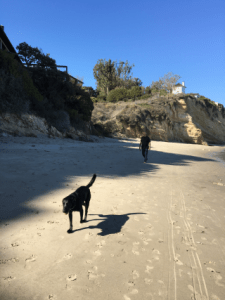
    Meanwhile I’d like to leave you with a final surfurbia image, or if you prefer, paint it in a “plein aire” light: A sixty-year old woman hikes with a much taller man, hand-in-hand down the steep gravel path to the beach. There, she watches her partner in life toss the ball to a couple of black dogs. Now, standing at the shore (looking like a full on beach Martian), she bows her head, as if in a prayer of gratitude. She waves to the man on the beach before she sets out for a swim. She thinks of him as her beach lifeguard, and her lifeguard in life. Smiling, he waves back.
  • Driving in the rain
    Prayer for Rain

    We’re waiting. We’re ready. We’re told it’s coming but it hasn’t happened, and we’re wondering, will it ever come? This four- year North American Drought gets scarier by each crusty day.

    The Santa Monica Mountains near my home are brittle and brown. The riparian shrubs shrivel while the mule deer and the coyote visit our backyards seeking moisture.

    Climatologists said a significant rain would fall by December that some 60 inches (now revised to 30) could dump by the time the rainy season ends. Now, hours away from an alleged heavy weekend storm, we’ve not seen much but for a sudden and subtle shower, just wet enough to slicken our driveways. Is it wishful thinking to believe the headlines that read “95% Sure El Nino Coming”?

    In the Jewish religion there is a special prayer that asks God for rain. The aptly named Prayer for Rain is an acrostic poem written by the medieval mystic Elazar Kalir. It is recited on the final day of Sukkot, the harvest festival that immediately precedes the rainy season in Israel.

    The idea of a prayer for rain conveniently reinforces my need for something “bigger” than mere mankind to end the drought.

    Cavalierly I appeal to the heavens. “Please, let it rain,” I whisper to some otherness as I watch the slate-colored clouds cross the ocean towards land. I pause to see if the nimbo-cumulous open their silver lining to rain upon our coastline.

    Mostly, they evaporate. Ah, so much for my whispering wish- craft.

    The writer Kalir might have been a magical thinker too. It is not uncommon for poets to hear voices, imagine things, be inventive. In the prayer he speaks of an angel of rain, Af-bri, who does things very much the way I would like to see things get done: Af-Bri “overcasts the sky, forms clouds and precipitates them, making them rain.” Specifically on Israel, Moses said, for Israel was “peculiarly dependent on rain.” Based on the drought statistics, I would say Southern California is also peculiarly dependent on rain right now. But let’s look to the sky.

    During 2012-2015 a persistent atmospheric high pressure system over the Eastern Pacific Ocean has been disrupting typical storm tracks heading west, creating dry weather conditions for the West Coast. The pattern is called: The Ridiculously Resilient Ridge, or the Triple R. Such a nickname! Leave it to scientists to make up a silly name to coax humor around a condition that like a domino effect has the potential to manifest catastrophic global conditions. Nevertheless, this phenomenon has exacerbated the dry climate indigenous to Southern California. Thank you science for explaining things.

    Science, as it were, just might be the kind of “angel’ necessary to make water. Because we share similar ecological characteristics with the Mediterranean, an Israeli company is sharing its drought-busting desalinization technology with the county of San Diego. If the desalinization works, couldn’t we say our prayers have been answered?

    Could it be that when Kalir writes about his country’s dependency upon water, he could be writing about that place as a metaphor for something that we all are? That all of us, and most living beings are dependent upon water, and thus fundamentally there is no difference between us? After all, the human heart and brain combined add up to 65% of total body water I contend it is un-peculiar to be dependent on rain!

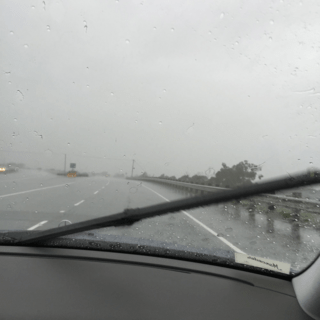
    I think the best part of Prayer for Rain is Kalir’s understanding of a judicious rainfall. “May [The Divne] apportion due portions of rain….” By asking for the right amount of rain, during what should only be the rainy season, Kalir acknowledges the dirtier side of a big storm, like an El Nino event that can cause flash floods, turn boulevards into “rescue” channels paddled by canoe, drown folks in their own cars. My own “Nino” event happened in 1997. Let’s just say it was fairly rough going when a saturated sloping hill pushed tons of mud through the back kitchen door, yellow taping my home for several weeks before I could return. For years after I suffered a post- traumatic stress disorder response by curling into a ball on the sofa anytime it rained.

    The concept of “apportioned portions” also paints the prettier picture of a good rainy season for California, with a hearty Sierra snowcap providing enough water to quench the needs of 39 million residents who live here. With the right infrastructure (we might as well pray for that, too), the state should be able to sustain its ripe status as the 8th largest economy in the world, bearing potential to advance to 7th place. As a California-centric, I grow excited by the thought that with the apportioned portions of rain California’s aqueducts and reservoirs would be replenished, and San Joaquin Valley homeowners would not have to belly up their position at the top of the state’s agrarian hierarchy. Those folks will be able to live out their days on apple farms, alongside their livestock, once again returning to the simple luxury of flushing toilets and washing dishes.

    As a vintner I want a judicious rainfall but hope it doesn’t rain during the harvest season when the grape asks for sunshine, not rain. Rain mixed with sunshine will mold the delicate fruit and disrupt the apportioned portions necessary for producing a good pour. I hate when that happens.

    The tradition of a daily morning hot water and lemon, or an annual new years day walk with a long time friend are some of life’s rituals that bring comfort to me. Whether it be age, or just life’s bumps and bruises, abrupt change and exacting surprises rattle me more than ever. Ritual through meditation or prayer or just something one does everyday can allay the fears and doubts that arise in the frightening world that is ours. It feels really good to know that some things can stay the same. I think the Prayer for Rain annual reading addresses this same need: it is a tradition that reassures.

    Like most Californians, I am desperate for rain, and Kalir's  medieval poem has given me permission to make up my own invocation for a wet winter. 

    As I wait for the precious water to boil in the kettle for my daily lemon drink, I will close my eyes and solemnly say to something deep within myself, “It’s going to rain. Just enough. It’s going to rain.”


  • Mandala

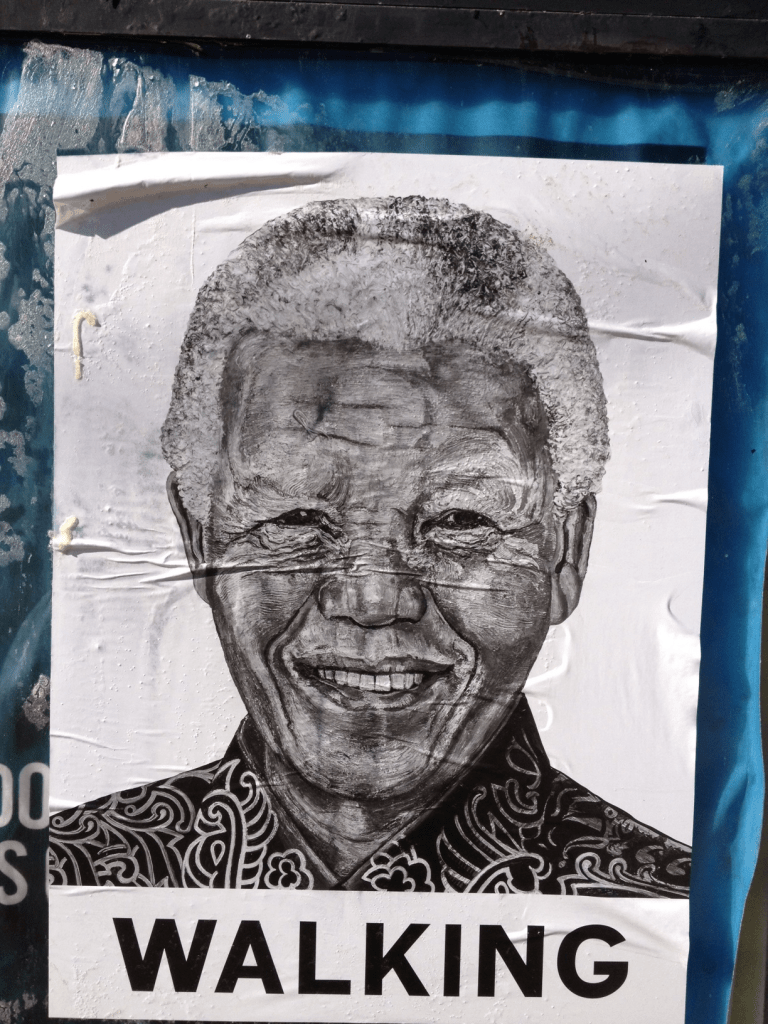
    At Westward Beach, Nelson Mandela’s face is posted on perhaps the only phone booth left standing within miles. The drawing is iconic guerilla artist Robbie Conal: an ink portrait of a noted public figure. But wait, this is not the usual Conal portrait of a familiar corrupt global leader, nor does it express the usual anger towards the establishment. It is the Tribute Poster of Nelson Mandela.

    Since the 1980’s Conal’s simple line drawings have been graphic depictions of notable subjects, and as a true portraitist, the subjects’ personalities. From Ronald Reagan to Clarence Thomas to Gorbachev to any number of Bushes. His gift is how he captures the essence of their political pursuits and lasting public impressions left in their wakes.

    Last Monday morning, two days before Nelson Mandela’s funeral, I was stunned to see the “Tribute Poster” for the first time, not on a city electrical pole or side of a wall, but there, next to the beach, the whales and the dog walkers. Conal’s depiction of one of the greatest leaders the world has ever known is slapped onto the plastic siding of the telephone booth. WOW! I am impressed. With mercurial fleetness Conal had been poised to post, not as a twitter in this case, but in an age old method of freedom of speech: a public posting! Conal’s portraiture, method and timeliness is spot on.

    Now, after a weekend of marvelous televised reportage of Nelson Mandela’s life and its’ ripples effected, these posters serve as a reminder of how profound it all is, so much so that I practically bow to this phone booth, to these cheap reproductions of an artist’s simple rendering. Here Nelson Mandela’s portrait smiles back at me: the archetypical embodiment of a saint, and yet a mere follower of democracy.  Deep life- lines, wire brush head of hair, crinkling smiling eyes and an inviting toothy grin.

    He will be remembered as a prophet and hero. In his suffering and studying, his separateness and isolation, he eloquently explained and bequeathed change. His presence was awe-inspiring. His lifetime: forever. 

    One poster says “Walking.” the other: “Dancing.” My naiveté gets the best of me and I fill in the blanks: “Walk,” I guess: to freedom?  “Dance.”  In celebration once one gets to freedom? Is that heaven? 

    Clearly, in the face of the blindingly beneficent beach existence of sun and surf and abundance, I am not for want: my life is full with what I consider freedom:  walk my dog, talk on the phone, wear what I want, shop, surf, read what I choose, and marry the man I love; freedoms denied to so many people in other countries.

     Somehow, on this cold Malibu morning with no sand sideshow distractions, I truly take note of these bold “poster” communiqués that not only express freedom of speech, but also a human rights campaign that does not tolerate a lack of freedom of expression, economic opportunity, sexual choice, health and educational rights. Does the poster say more to me now that the weekend media reminded me of the power of this man? Probably, but seeing these posters at the beach drives this big picture to my core. 

    Let’s hope the “Tribute Posters” stay plastered to the phone booths for a while or until someone invokes free expression by tagging or tearing them down.


VIEW MORE BLOG POSTS