• Little Temples
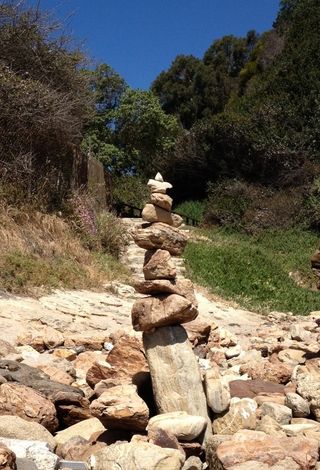
    Anyone who walks the shore
    along Little Dume has seen them. Depending upon the tide, the winds, or the
    urge for a kid to knock ‘em down with a kayak paddle or a baseball bat, they
    may stand for days at a time. Like little temples they stand, equidistant apart
    among the many boulders and rocks at their base, these “rock sculptures” demand
    one’s attention.

     On this particular Memorial
    Day the energy is peaking.  Later, the full
    moon will rise near midnight, and for now, a couple of hundred yards out, a quiet
    swell builds. Folks are gloriously happy in their swimsuits and wet suits in
    the water. The little temples seem to bless them with their somewhat monolithic
    presence. Some believe the little temples encourage ample surf.

    It’s a free look, art from
    nature not for sale, a peek at the mysteries of architectural laws, a
    meditation for the one who builds them.

    I had never seen “Mr. P.”
    actually build the sculptures until this particular day. He picks up a rock and
    carries it to an ordained place on the sand. Like most endeavors, and certainly
    artistic ones, this artist experiments with his medium: hoisting and placing
    rocks of different sizes, weights, and shapes. He adeptly places one onto
    another, the largest at the base, the smallest last—on top. “Mr. P.” moves
    slowly but deliberately like an experienced stonemason.  In harmony, the sculpture does not succumb to
    gravity, lose balance, or topple over.

    Three little girls come
    scrambling down the boulders to the beach. One carries a soccer ball. It is a
    long way from the boulders to the sand for these little girls and “Mr. P.’
    gallantly offers a hand. They thank him and together approach the little temple.
    One of the girls plucks the top rock from the sculpture. He looks at me and knowingly
    smiles. THIS HAPPENS! Our gazes return to the sculpture. The little
    girl has replaced the stone. By now, she and the others are running down the
    beach kicking the soccer ball in front of them.

    The little temples fascinate,
    and are there for all to see. I was sorry I did not have my camera but went
    back the next day. Only two were left.

  •  
    6a010535e8c6c2970c017eea8a73f5970d-800wi

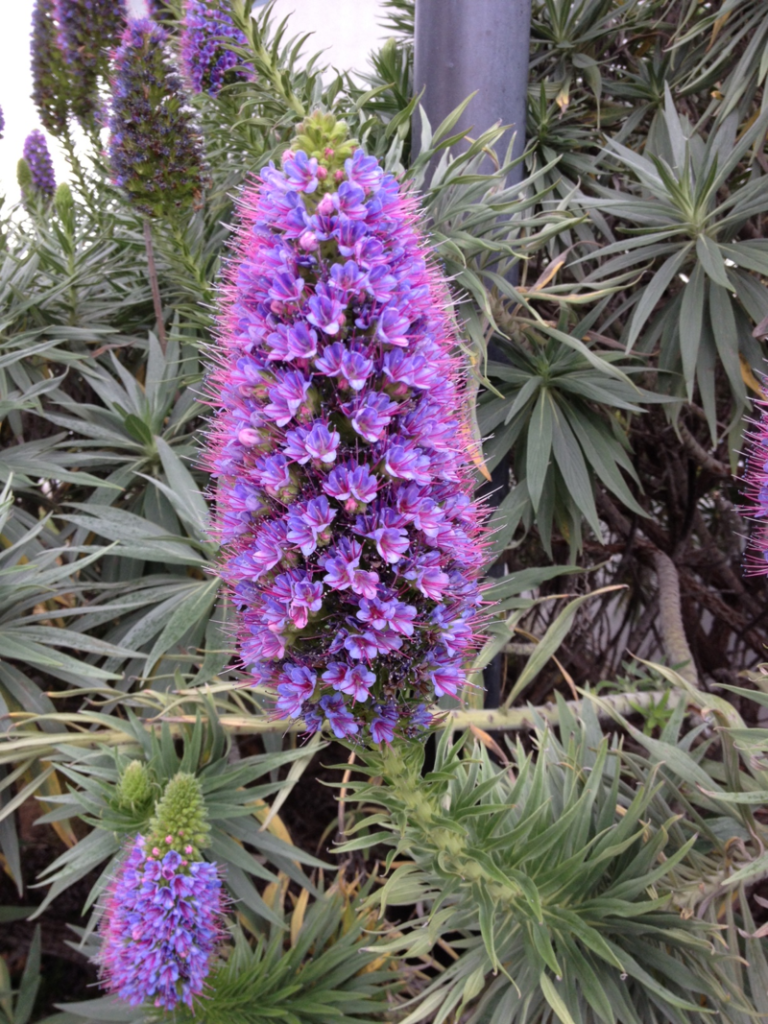
    The deliriously blue-purple
    conical shaped flowers you see shimmering along our arid coastline every Spring
    is the Pride of Madeira. I like to call it the Pride of Malibu. Its’ botanical
    name is Echium candicans which sounds like “eating candy” to
    me. Don’t try to eat it. From a distance this biennial
    subshrub
     looks fuzzy
    and soft, but in fact it is quite a defensive plant with taut spikes that jut
    outward from the cob at  its core. Look closely, and imagine as I do
    a Chopard bracelet made up of rows and rows of saphire and amethyst florets.
    Nature’s jewels.  And attract, it does.

    I leave this borage to the butterflies and bees to
    contently hum and flutter about the bright dome heads when in bloom.  Let
    them eat cake! So beautiful are these freaky flowers, you might want to handle
    their “clusters.” Warning! Do not touch without gloves, lest nature’s beauty
    will bite back causing serious skin chafing and allergic reactions.

    At the instant I photographed this Pride of
    Madeira with my iphone, its beacon of color filled me with the anticipation of
    Spring. Even now I marvel at the way the light upon the flower creates an
    illusion that light radiates from its interior.

    The Pride of Madeira is a native plant that
    originates from an island of the same name off the coast of Portugal, near
    Morocco. Madeira means wood in Spanish, which makes sense since the island once
    had vast forests.

    By sheer coincidence I recently rediscovered a
    book in my personal library called, “The Flowers and Gardens of Madeira”
    (publishers Adam and Charles Black, 1909), illustrated and written by Ella and
    Florence Du-Cane.  The book evokes a genteel moment in time when a pair of
    traveling women might have found a freedom of expression in the writings and
    artistic considerations of private, walled, and public gardens. Ella’s pen, ink
    and watercolor paintings are charming studies of flowers in-situ: fountains,
    pathways, terraces and cliff sights, all stunning in detail, color and
    composition. Along with Florence’s in depth descriptions and historic
    references, the Du-Canes fulfill an image of a one time Mediterranean paradise,
    and a more romantic era.

    Writes Florence: “Lovers of flowers—and to those
    I most recommend a visit to the island—will find fresh beauties even at every
    turn of the street…”.

    Now an antique, the illustrations and colorful
    narrative in “The Flowers and Gardens of Madeira” brings to minds eye the end
    of the "Gilded Age," and perhaps a scene executed by the master
    watercolorist himself John Singer Sargeant. The painting would feature the
    sisters Du-Cane in ankle length dresses under parasols, one with a sketchpad, the
    other taking notes. At the plaza water fountain, arm in arm on a cobbled road,
    or perhaps sharing tea with Edith Wharton and Henry James in the shade of a
    villa garden by a wall dripping in brick red Bougainvillea spectabile.

    Madeira, 37 miles in length and 14 miles wide,
    impressively possesses topographical characteristics of both California’s North
    and South. Because of its high elevations and peaks, Madeira boasts a sub
    tropic climate such as that of Northern California. In fact, the Du-Cane’s
    describle Madeira’s 6000 foot peaks as a “miniature” landscape, and similar to
    the “grandeur to that of the Yosemite Valley.”

    Meanwhile, Madeira’s proximity to Africa lends a
    dry climate similar to Southern California’s arid landscape. And while we
    suffer the Santa Anas, Madeira, like its southern European neighbors, bears the
    “Leste,” a hot south Eastern wind blowing from the Sahara. It’s no wonder we
    have so many of the same plant varieties, to wit, the Datoura (and deadly!)
    trumpets; the ethereal Jacaranda buds that carpet our streets in June;
    December’s holiday-ish Flamboyants, better known as Poinsettias; the ever
    charismatic Purple Bougainvillea “creeper” that subsumes our porticos. And for
    a brief period each Spring, the brave and the bold purplish-blue Pride of
    Madeira.

    I photographed my Echium Candicans outside
    Malibu’s City Hall in early March, which was premature for Malibu’s Pride of
    Madeira season. I have to guess its “bolting” was attributed to the “false Spring”.

    I had never noticed this plant in that location
    adjacent to a parking lot I use weekly. Cars can bump it and it will bump right
    back.  After all, it is hardy and strong and has evolved to withstand
    headwinds on the cliffs at coastlines. I wonder: did the City of Malibu plant
    seeds here, or replant an existing plant? Or maybe they built around it? Any
    way you look at it the Madeira was in Malibu long before any concrete was.

    Picture this: As Juan Rodriguez Cabrillo leaves
    the Bay of Funchal in Madeira, Portugal he plunks some Edium Candicans seeds in
    his uniform pouch. When he gets to the land of the Chumash on the Baja coast in
    1543, he is mesmerized by its’ natural beauty, and embraces the vista that so
    resembles his homeland. As he makes his way to a higher ground hoping to get a
    better view of the lagoon, Cabrillo grabs at chaparral to secure his footing.
    As he reaches for the wild grass, the seeds from the purple flowers of Madeira
    fall from his pouch, into the poor, clay soil. As Cabrillo climbs uphill, the
    soles of his thick leather boots bury the seeds, for good.      


  •  How can we lower the rodent population in a humane way, but keep the owl community thriving?

    At first it was the bold, haunting image that caught me.
    I merely glanced at the advertisement: the somewhat magnified photo of a raptor’s
    large amber orb of eyes and the dark, lifeless varmint in its beak declaring,
    “You call them rodents. We call them dinner.”

    In that moment I took the ad to suggest we should not kill
    rats and other pests in order for the owl community in Malibu to survive. This
    intuitively suggests an imbalance of nature might take place as we annihilate
    the 27 mile stretch of rodents, thus potentially starving out the owl
    population. I love owls, I appreciate them, I like the way they hunt, and I
    want them to be active rat catchers. I also believe in owl houses to make their
    job as hunters more efficient. I honor their magical qualities as well
    as their mystic presence much in the way the Indians do.

    But who likes rats? I know someone who has a pet rat.
    My friend said her pet is much like a dog, responds to its’ name and likes to
    have its tummy rubbed. But the pet rat gets sick alot and my friend gives it medicine.

    When I think of rats I imagine a scourge of these little
    beasts known to spread diseases such as salmonellosis, fowl cholera, and
    bubonic plague scampering up our craggy cliffs, across our orchards, up into
    our eaves, and scratching between our walls. BTW: plagues still exist and have
    been accounted for in Asia, New Zealand and Australia where one afternoon a
    farmer had to kill 70,000 rats. I read in a recent New York Times article that
    ten owl families living in a barn in Florida “cleared the surrounding sugarcane
    field of 25,000 rats a year.” Hello! Rats can thrive. 

    Obviously rodent control is not just a local issue.

    According to
    an animal behavior research group out of England, “…it has been estimated that
    between a fifth and a third of the world’s food supply never reaches the table
    because of losses to rodents.”  You like
    cute little house mice? Good, because there are plenty of them. It is said they
    are the largest mammal population on earth. And they will gnaw away at your foodstuffs
    faster than you can say, “pass me a Dorito.”

    Amidst these cheeky ruminations I return to the
    advertisement and on closer inspection realize the thrust of this paid for
    message is an appeal to humanely treat rodents by encouraging the reader to
    refrain from using poison products to kill them. The owl in the ad states, “I
    prefer my meals poison free.  Please stop
    using poison products.”

    Fair enough, and very clear, and even perhaps
    charming. I apologize if I have appeared coarse, but because their numbers
    suggest rodents know how to exponentially multiply, I prefer extermination
    thru innovative and creative control methods. I have weighed the "risks" versus the "benefits" and I think dogs, snap traps and raptors are the best way to go. But, if that doesn't work ( better to hire a professional here), you might want to consider  a bait ( compressed grain wafers) and a bait box. The wafer should contain 1/2 oz to 1 ounce of "rodenticide"  called "contac." It only takes that much to kill an average size rat.  According to the professionals who make a study of "rodent control" it takes up to 15% of an animals body weight to get a lethal dose. 

    Oh yeah, did I mention "sticky boards" which does away
    with roughly 20 million rodents per year in England?  Look it up.

    Back to the ad which  asks us to play nice, and to consider animal
    welfare and the unintentional death to creatures who coexist as part of the Malibu food chain.  Unfortunately using poison as a pest control method proves to be a risk to
    “non target” creatures, which in this case  is the owl. 

    Having lived most of my life in the city until I moved
    to Malibu, I never had the thrill, or the experience to listen to and track the
    screech owl’s sharp cry, nor the barn owl’s murmuring “who who.” Like so many
    Malibu residents I too have imagined the owl’s mystical presence. The owl
    enchants.

    The American Indian glorifies the owl as a shamanistic
    creature, and I appreciate and find comfort in this mythology. In that magical
    place the owl has other worldly affiliations, symbolically noted with one eye
    closed and one eye open—thus referring to a presence in both the afterlife and
    the life we live now.

    Multiple generations of owls have returned to the
    eucalyptus, sycamores and ravine outside what is now my window for hundreds of
    years, maybe even in the “before” alongside the Chumash Indians who thrived
    here.

    However, I am still left with the notion that I am punishing
    the raptor by sweeping away the kill that is the component of its food supply. This pains me, but in
    truth, I have little concern the local raptor population does not have enough
    to eat. I trust that varmints of multiple varieties thrive in our local
    ravines, brush, canyons and holes. 

    There isn’t a day that goes by when I don’t see hawks
    flying over PCH, the hiking trails, or the fields. As the hawk lives, so does
    the falcon, the osprey, the owl. If these raptors experience a dearth of
    carrion here, why wouldn’t they migrate somewhere that would provide a veritable
    cornucopia for their brood?  You might
    say I believe in this basic tenant of migratory pattern and evolution. For now
    they are happy in Malibu.


VIEW MORE BLOG POSTS